
‘Big Sex Little Death: A Memoir’
Susie Bright, Seal Press, 304 p, $24.95 hc
“How does a woman, an American woman born in midcentury, write a memoir?” Susie Bright asks in the preface to her quirky, raw, surprising memoir Big Sex Little Death. Many women, of course, have done what Bright rather cynically calls “the autobiography racket.” In Bright’s view, these books break down to diet/makeover books, star tell-alls, or dysfunctional-family memoirs, where the writer explores the great psychic burdens that have been laid on her by family toxicity and makes it out clean and cured in the end.
Well, Bright tells us straight off that she doesn’t want to do that third type of book—though she certainly has the material for it. Here’s Bright’s self-appraisal: “I have always been curious—and empathetic. I haven’t set any records in sexual feats or numbers—far from it. I was motivated, always, from the sting of social injustice.” It’s how Bright likes to see herself, that’s clear; yet after reading her memoir, a strange mashup of honesty, sexual compulsiveness, loss and dysfunction, humor, sadness, anger, and a fluid range of sexual behaviors, it’s hard to know what to think of her or her life. For me, there’s always been an admirable, compelling mix in her writing: unabashed hedonism and a teacherly/activist quality that becomes almost lovable when her topics are undeniably kinky: how to fist, how to “read” porn, for example. Yet this seemingly confidant woman came from somewhere: what’s saddening in this memoir is to learn how precarious and unmothered her early life was, how her parents to some degree always remained strangers to her. That may not be the takeaway that Bright wants, but she’s honest enough to give it space in the memoir, and it’s like a dark current that runs through an otherwise “bright” life.
Susie Bright was a bigger-than-life character in the late ‘80s when I arrived in San Francisco. I saw her first onscreen, in Monica Treut’s self-consciously queer The Virgin Machine. She appeared there in leather, tall, smiling, open-faced in her persona of Susie Sexpert, clasping a box of sex toys, which I remember her opening with gusto, showing the virginal young woman of the title—and us—a hint of what was possible in sexual terms. In the 1980s, of course, Bright edited the erotic magazine On Our Backs, which had a gritty, edgy bite and was filled with explicit photography and porn spreads. A lot of young lesbians bought On Our Backs, including me, and this savvy, unshockable, confident, wickedly verbal femme Susie Bright was a big part of the ‘80s and early ‘90s milieu in San Francisco, part of our education. What we didn’t know was that this was Bright’s second act. Her first act, explored with almost minutely detailed ebullience in Big Sex Little Death was as a gutsy, slutty young revolutionary in Southern California: She joined a cultlike, left-wing group called the International Socialists in high school and, alongside a heady period of sleeping with whomever she wished, became intensely political.
These two group experiences were formative for Bright. In the first, she went from shy schoolgirl, berated and shamed by her mother, to being wild-child feminist Susie in a group of slightly older men, a role that she obviously craved. At On Our Backs, too, starting in her mid-twenties, she worked with women, strippers and dancers, who were older, wiser, more sexually experienced: dyke whores, she calls them. When I bought On Our Backs in the ‘80s I’m sure I had no idea—though the evidence must have been on every page!—that the women running the magazine were actually professional strippers working at the Mitchell Brothers’ O’Farrell Theater. It’s strange to think of Bright flourishing in these two hidden subcultures—and yet both experiences ended with her being cast out of Eden.
But her first rejection bit deep. Bright was born in 1958, conceived on board ship as her linguist parents traveled back from India. In a strange twist, her parents had divorced by the time she was 2, leaving her with only a blurry idea of what her parents’ life together must have been. This must have been hard—to be the only child of two intelligent, contrarian parents who had already split up and were bitter about each other by the time she came to consciousness. Bright’s father, Bill, was a nerdy, affable academic, married four times; she lived with him from the age of 14 on. Her mother, Elizabeth Halloran, was from a troubled Irish family in Fargo, ND. Bright recounts that 12-year-old Elizabeth cradled her dying mother in her arms just after she gave birth to her fifth child. This vibrant, intelligent woman was also extremely volatile and haunted by her demons—her alcoholic, abusive father had walked out on his family, as well. A librarian, Elizabeth moved them around restlessly throughout Susie’s childhood, culminating in a scary quasi-suicide attempt in Canada when Bright was 14, when she threatened to drive them both into a river. In describing her mother’s moods, Bright doesn’t use the word “bipolar,” but it comes across. After verbally and physically abusing her daughter, Elizabeth would be contrite: “She’d cry and say that she was sorry. She wanted me to hold her tight.”
Bright was thrilled to go live with her father in Santa Monica at age 14, after his third wife died of cancer. Yet one wonders how living with an absent-minded and detached, if well-meaning, parent, could really have prepared Bright for a healthy adolescence. She hadn’t grown up with her Dad, she says; she called him “Bill,” and she did all the cooking and cleaning… “Bill didn’t get mad with me about anything,” Susie writes. But Bill also didn’t enforce any boundaries. Bright doesn’t fault him for that—but their relationship seems to have consisted of fondness mixed with emotional avoidance, at least until her daughter was born.
And so, the girl who didn’t really know her parents—both parents born in the 1920s at a time of sexual repression–suddenly became a hip young thing of the mid-1970s, starting off her sexual life with a threesome. Bright wanted a sexual revolution. Though she says that women were more important to her than men, it doesn’t ring true here, as most of her hot 1970s sexual experiences were about navigating sex with men by asking permission of their wives and girlfriends! This sounds perverse to the reader of 2011, but doesn’t it seem right that a girl who’d been so unparented would gravitate towards group sexual experiences and nonexclusivity? It seems to have been hard-wired into Bright early. I like this excerpt from the time when precocious 17-year-old high-schooler Susie is contemplating a fling with Stan, a branch organizer in his late 20s. First she has to ask Shari, the woman he is sleeping with. Shari tells her to go for it… Stan is a great fuck. Bright comments:
Shari was so low-key, just the way I imagined it would be after a massive sexual revolution. Women wouldn’t be catty. No one would bother to be jealous. Who would have the time? Sex would be friendly and kind and fun. You’d get to see what everyone was like in bed. You’d learn things in bed, and that would be the whole point…. You could have all the sex and friendship you wanted for free. Exclusivity would be for bores and babies.
And Susie does have a hot-and-heavy affair with Stan. It doesn’t end well—she’s booted from the International Socialists after living in Louisville, Kentucky and doing political work there. Faction turns against faction, and Bright is out. Stan sends her a brief goodbye telegram telling her she’s “a sweet kid.” She wonders what happened. These were the people she wanted to spend the rest of her life with, her chosen family. They’d spurned her and she was alone again. Her dad had to send her a plane ticket. “I couldn’t get over it, that my dad wanted to help me,” Bright writes, those confused words speaking volumes.
It becomes the paradox of the book that Bright’s chosen families do reject her, including Debi Sundahl, the glamorous publisher of On Our Backs who’d been her mentor and friend as well as boss. I loved reading about the On Our Backs years and felt disturbed as Bright details the lack of money, the way it all went bust after Debi was fired from her Mitchell Brothers job and became determined to marry a wealthy Marinite. Who knew at the time that this was all that sustained the magazine? Debi ended up suing Bright, threatened by her reasonable desire to quit and find a more solid source of income, and it’s very juicy to read these secrets. But there’s not enough analysis on Bright’s part of why these people felt betrayed by her—betrayed enough to cast her out. It’s clear from her stories, if not from her own insights, that the survival instinct in Susie Bright, always strong, flares up at times of transition and that others interpret this as betrayal.
Finally, because Bright writes with insight and affection about her parents’ backgrounds and relationship at the beginning of the book, I hoped that towards the end she would write about their deaths. (It may be perverse to want more death in a book called Big Sex Little Death, but that’s what I felt.) Her long-divorced parents did rally around when Bright became pregnant as a single parent at the age of 32. When Bright writes about Aretha’s birth and about choosing to live with partner Jon and decamp to Santa Cruz after the On Our Backs flameout, there’s a palpable sense of freedom in her words. Nobody should begrudge anyone a private happiness, and if Bright’s decision to have Aretha and live with a man went against her erstwhile public persona as a lesbian—which she doesn’t discuss—so be it. It’s clearly brought her personal satisfaction. Despite admitting to sometimes blowing up at her daughter and needing support to parent her, she does feel she’s done it right and has loved being a parent, deriving strength from it. In a flash of insight, Bright writes: “My activism was always maternal, and I never knew it before Aretha. I knew the fight in me was creative, erotic, intellectual, historic—but I never knew it had a nurturing engine.”
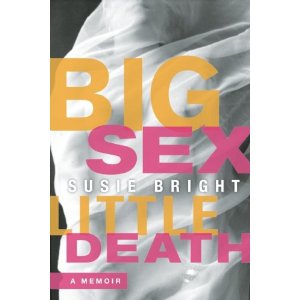
'Big Sex Little Death' was published by Seal Press in April 2011.
Bright still considers herself a sex radical, edits erotic anthologies and hosts a radio show called “In Bed With Susie Bright.” She’s clearly proud of her past and she should be proud of this memoir, too, though I would have liked to read more about her long-term relationship with butch photographer Honey Lee Cottrell. Her love for her parents is evident throughout the book, giving it a serious focus. An iconic photo of them together shows an open-faced, smiling woman and a shy, bespectacled young man. You can see Susie in her mother’s face, yet the sensitive nerd aspect of her father appears to have had greater influence and steadying power on her. Both of these warring personalities went into forming Susie Bright, whose path has not been easy. As Christopher Hitchens, another complex, feisty Aries (and International Socialist member!) described his memoir Hitch-22, it’s about “the divided self.”


 Gabriella West